Controlled SOPs, traceable training, audit-ready evidence — in one quality system
AQ QMS is the governance backbone for clinical research organisations who need controlled document management, structured approvals, training linkage, and inspection-ready evidence — without the burden of an enterprise QMS built for pharmaceutical manufacturing. Sits alongside AQ eISF for study-level governance, or stands alone where SOP and training pain leads the conversation.
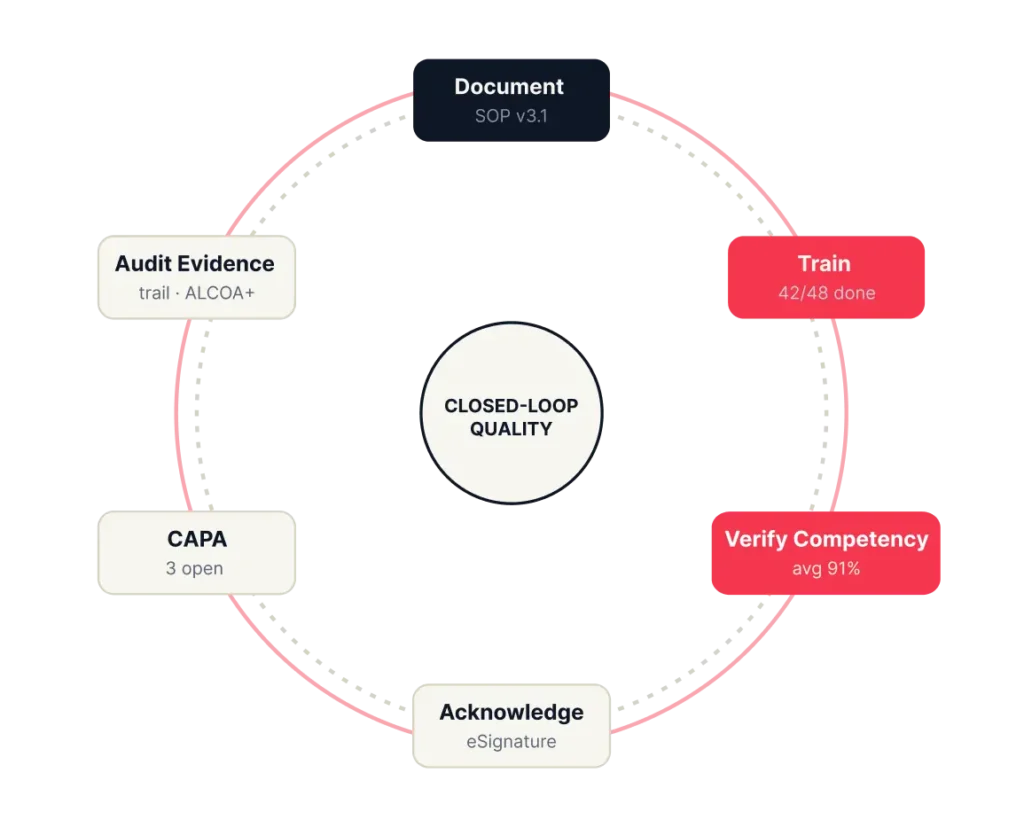
Compliance loop · live
96% COMPLETE
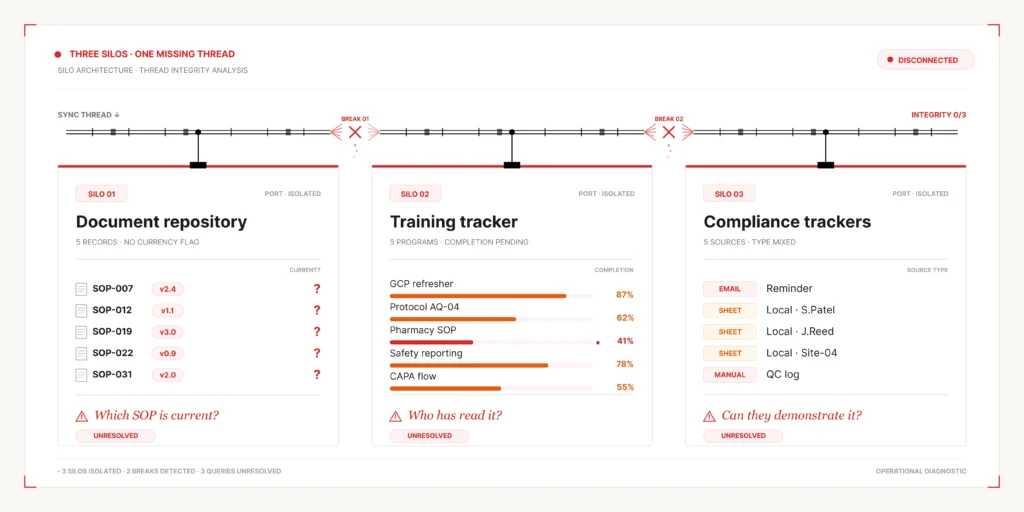
Three silos. One quality team trying to hold them together
Most research organisations keep controlled documents in one system (a shared drive, SharePoint folder, or document repository), training records in another (a learning portal, spreadsheet, or paper sign-off sheet), and competency evidence in a third (or nowhere). Each silo answers half of a question the inspector asks in full: which SOP was current, who had read it, and could they demonstrate it in practice? When the answer requires reconciling three systems, the quality team is doing verification — not governance.
Limited staff compliance
visibility
Unreliable oversight of who has read documents, completed training, or acknowledged updated procedures. Compliance status across teams remains unclear during operational reviews or audits.
Manual training
and QC follow-up
Reliance on reminders, spreadsheets, and manual checks to confirm training completion. Administrative effort increases while structured quality oversight receives less attention.
Weak proof of
training completion
Audit preparation requires reconstruction of evidence across multiple systems. Quality teams assemble document access history, training logs, and acknowledgements manually.
Inconsistent quality
practice
Uneven awareness of procedures across teams and study environments. Different interpretations of quality guidance across studies and operational sites.
Controlled documents, traceable training, and provable competency — connected.
AQ QMS replaces the three-silo workaround with one connected environment. Controlled documents with enforced approvals and version control. Training requirements automatically assigned to the right staff for the right SOPs. Competency validation that goes beyond “I read it.” CAPA linkage so that findings drive document, training, or process change. Governance visibility for leadership; structured evidence for inspectors.
Structured document and QC oversight
AQ QMS brings controlled documents, quality reviews, and QC activity into one organised system, powered by end-to-end CTMS. It makes it easier to access current procedures and follow consistent quality processes.
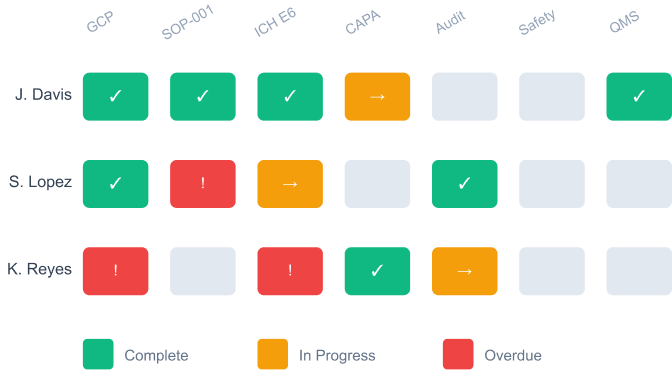
Visible training requirements and completion
AQ QMS helps teams assign training, track completion, and monitor outstanding requirements. So, this way the compliance status is easier and clearer to understand across staff and operational teams.
Competency validation beyond training attendance
AQ QMS facilitates teams to create quizzes and assessments for specific procedures, updates, or new requirements. It helps confirm that staff understand critical guidance rather than simply completing training.
Early identification of compliance gaps and resolution
AQ QMS highlights overdue training, missing acknowledgements, and unresolved quality issues earlier. In fact, integrated CAPA helps teams manage findings, corrective actions, and resolution in a structured way.
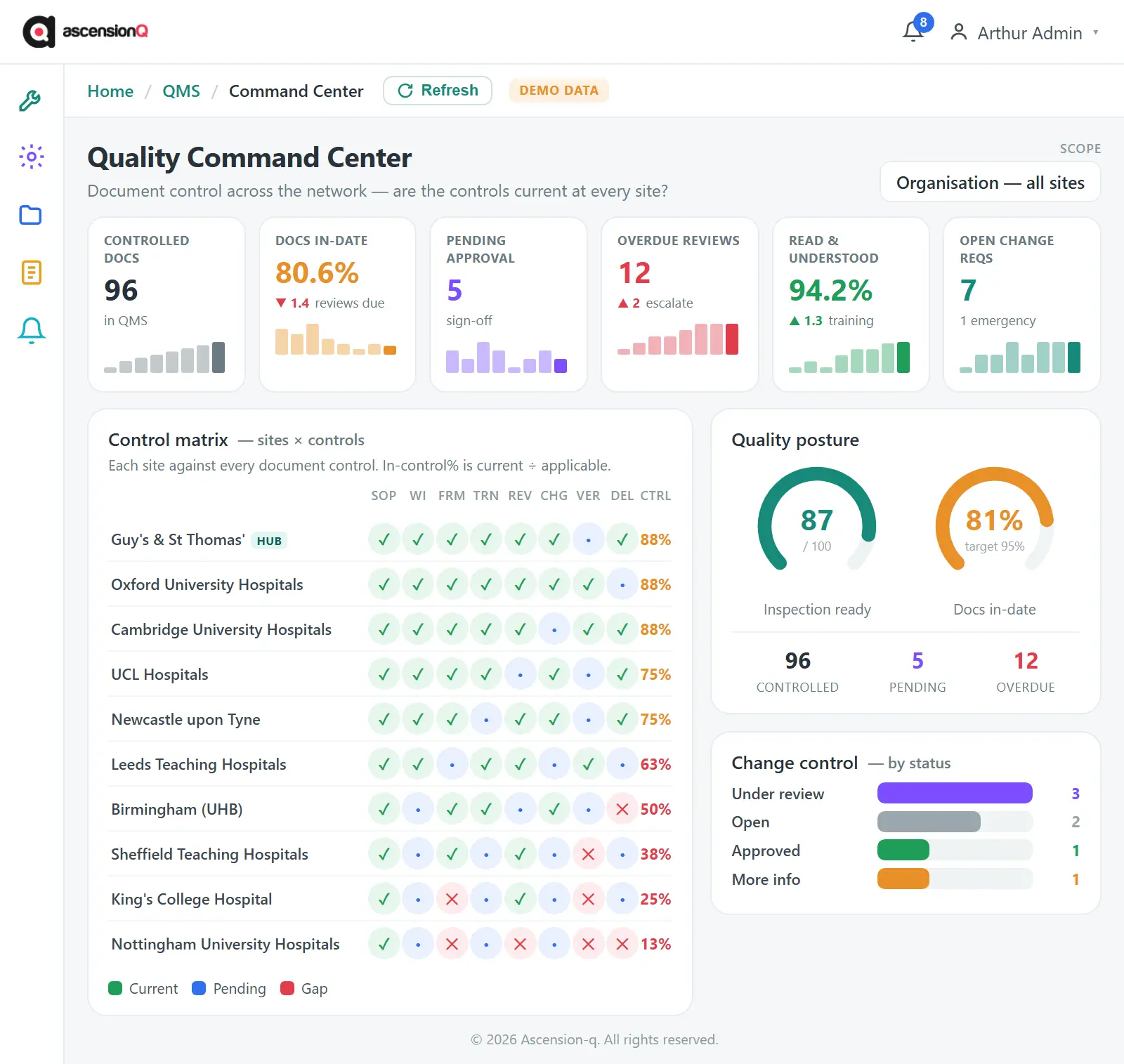
Core QMS capabilities for quality control, compliance, and audit readiness in one place.
AQ QMS provides the core controls required to manage document governance, QCvworkflows, training requirements, competency validation, staff compliance monitoring,vand corrective resolution within one connected quality environment. All aligned withvregulatory expectations such as Good Clinical Practice (GCP), UK GDPR, the DatavProtection Act 2018, and inspection standards followed by the MHRA and research
sponsors.
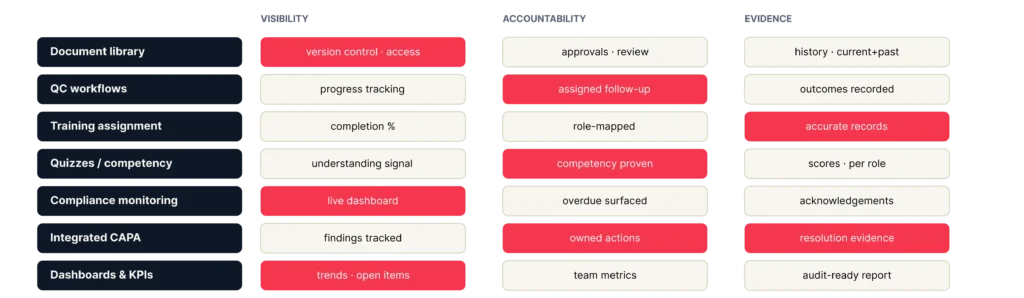
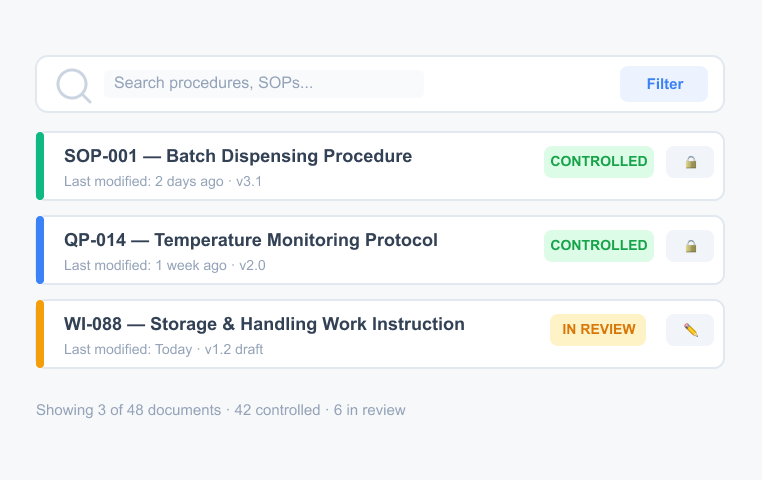
01 — Controlled Documents
Controlled Document Library
Centralised repository with version control, access permissions, and document review tracking. Publish updated procedures and maintain visibility into current and historical versions.
02 — QC Workflows
QC and Review Workflows
Configure QC workflows to review documents, processes, or operational activities. Track review progress, assign follow- up actions, and record outcomes to maintain consistent quality control.

03 — TRAINING
Training Requirements and Assignment
When staff are assigned an SOP, their acknowledgement is captured, time-stamped, and tied to the specific version. The audit trail shows who read what, when, and at which version — without paper sign-off sheets or chase emails
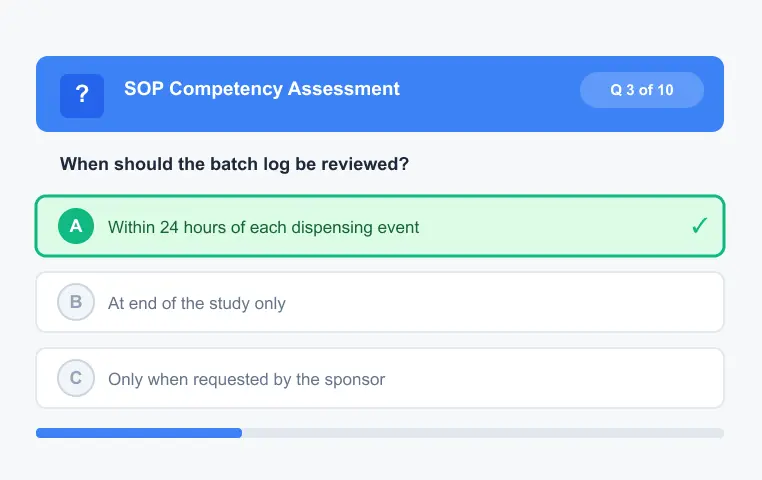
04 — COMPETENCY
Quizzes and Competency Checks
Create quizzes and assessments linked to procedures, SOP updates, or training modules. Design customised questions to confirm staff understanding and monitor competency across operational roles.
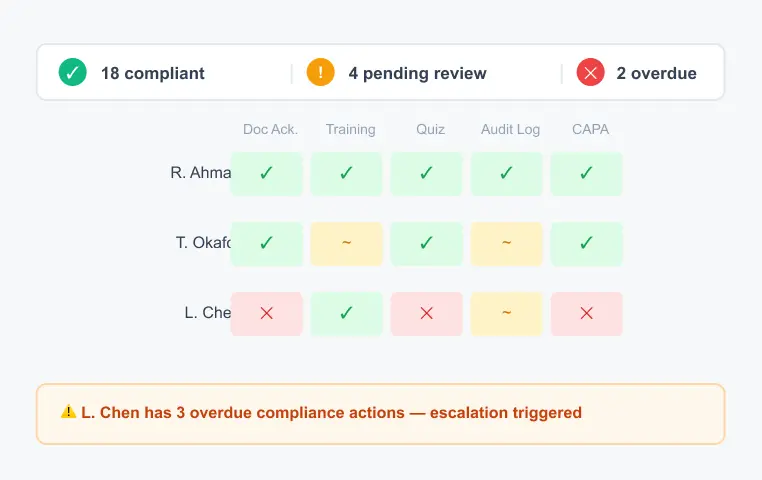
05 — Staff Compliance
Monitoring and Compliance Oversight
Monitor compliance across document acknowledgements, training completion, quizzes, and required quality activities. Compliance dashboards highlight outstanding actions and overdue training.
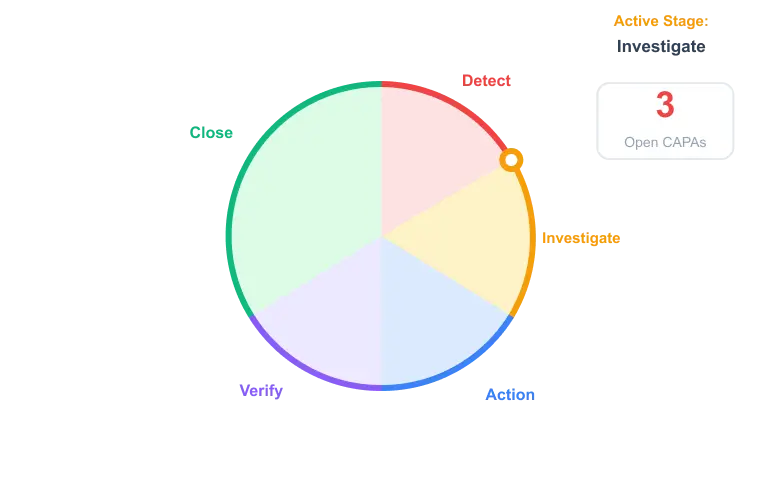
06 — CAPA MANAGEMENT
Findings and Corrective Action
Manage quality findings, deviations, procedural changes, and corrective actions through integrated CAPA workflows. Assign ownership, track steps, and monitor resolution within the same quality environment.
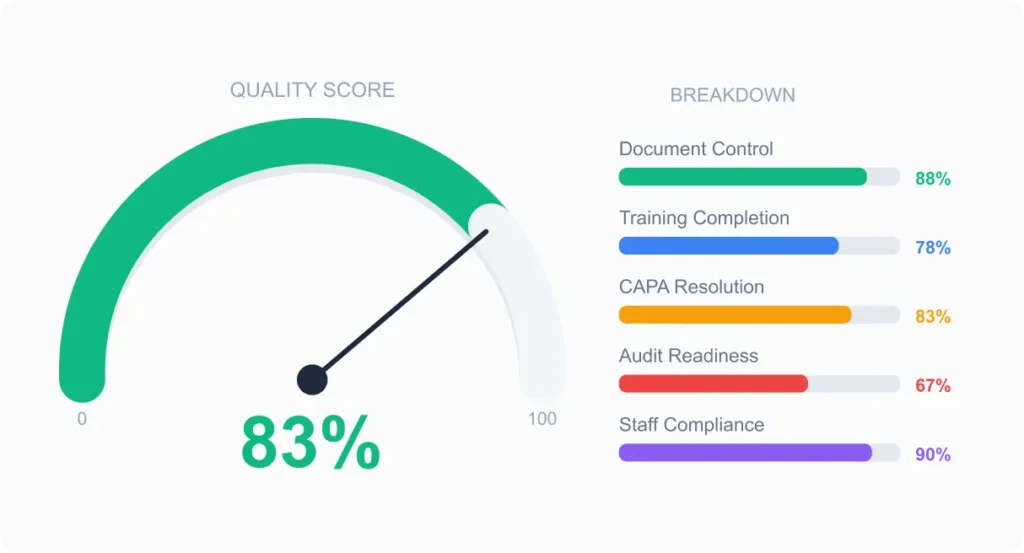
04 — DASHBOARDS & KPIS
Quality Visibility and Reporting
Use dashboards and quality KPIs to track document updates, training completion, compliance activity, open CAPAs, and recurring quality trends across research operations.
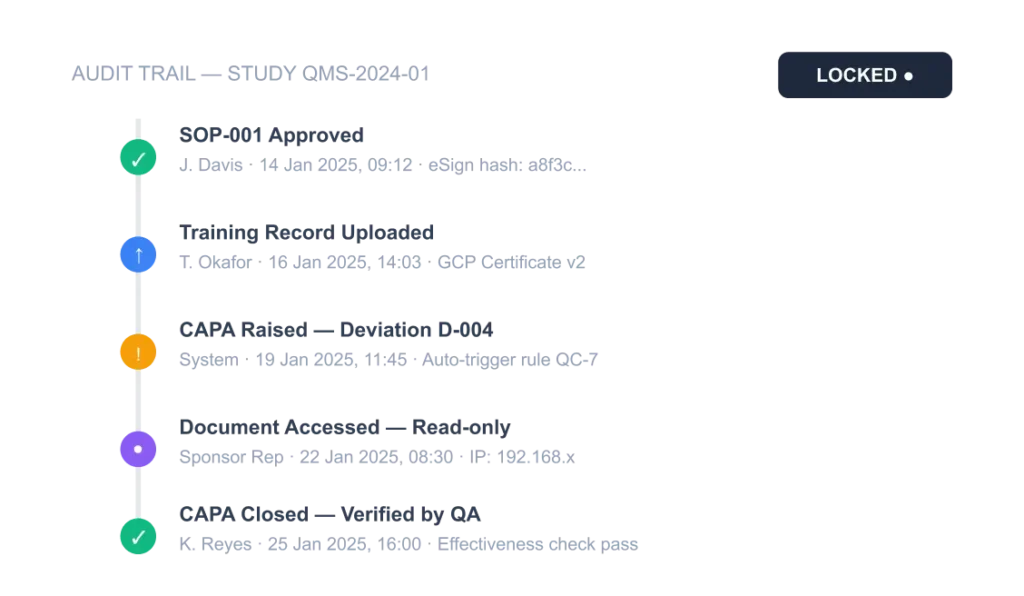
05 — AUDIT AND COMPLIANCE
Audit Evidence and Records
Maintain complete records of document access, QC activity, training completion, quiz results, acknowledgements, and CAPA actions — clear evidence of compliance during audits or inspections.
Quality Control That Stays Visible, Accountable, and Inspection-Ready
AQ QMS offers consistent visibility into completion status, unresolved gaps, and follow-up actions across research operations — so clinical research organisations maintain reliable compliance evidence and stronger audit readiness, every day not just the week before MHRA, FDA, or sponsor audit pressure arrives.
Clear Accountability Across Quality Processes
Quality expectations connect to specific users, responsibilities, and
follow-up actions — making it easier to track completion across
documents, training, and corrective activities.
Continuous Visibility Into Compliance Activity
A live view of training completion, document acknowledgements, and
unresolved quality actions across research operations — always
current, never reconstructed.
Simplified Audit Preparation and Evidence Review
All records stored in a structured way — clear evidence of staff
awareness, training completion, and corrective follow-through during
audits or inspections. No more delays.
Consistent Quality Practice Across Research Teams
AI-powered QMS capabilities help set clear expectations with visible
completion tracking — enabling research quality teams to follow
procedures consistently across studies, sites, and operational roles.
Built for teams responsible for quality governance, staff compliance, and audit-ready operations.
Quality and Governance Teams
Research governance leads, QA managers, and document control owners responsible for SOPs, controlled documents, training linkage, and inspection readiness. Replace SharePoint folders, email approvals, and parallel training trackers with one connected quality environment
Training and Compliance Owners
Training leads and compliance officers managing role-based training assignments, document acknowledgements, and competency validation across studies and teams. Demonstrate that the right staff are trained on the right SOPs at the right versions — automatically.
Research Operations and Site Leadership
R&D Directors, Heads of Research, and Site Directors who need governance visibility without manual reconciliation. See which SOPs are current, which staff are compliant, and where the gaps are — in real time, across studies.
Sponsors and CRO Oversight Teams
Sponsors and CROs auditing sites can review structured quality evidence directly — controlled documents, training records, acknowledgements, and CAPA linkage — without repeated document requests or evidence reconstruction.
Why trust AQ QMS, a flexible and scalable quality platform?
Most quality management alternatives sit in one of two places: enterprise QMS platforms built for pharmaceutical manufacturing — heavyweight, expensive, slow to deploy, and configured around production quality not research quality — or general-purpose tools (shared drives, SharePoint folders, email approvals, paper training logs) that fail the first inspection that tests them. AQ QMS was built for the gap in between: a structured, validated, inspection-ready quality system designed for clinical research organisations, deployed in weeks, priced for research budgets, and connected to the rest of the AQ platform.
Flexible quality
workflows for modern
research
AQ QMS adapts to the way research teams already work. Document governance, QC workflows, training requirements, and corrective actions can be configured to match organisational processes rather than forcing teams into rigid system structures.
Configurable modules
that scale with research
growth
AQ QMS modules can be configured and expanded as research programmes grow. Organisations can start with core quality governance capabilities and extend the platform as operational complexity increases.
AI-assisted quality
monitoring and insights
AQ QMS uses AI-supported signals to highlight compliance gaps, overdue training, unresolved actions, and emerging quality risks. This helps teams identify issues earlier and respond before they escalate.
Affordable and practical
for research teams
AQ focuses on practical implementation and operational usability. Research organisations gain enterprise-grade quality governance without the high complexity, long deployment cycles, or cost barriers often associated with traditional QMS platforms.
AQ Quality Management System implementation.
AQ QMS supports a smoother transition toward a more structured quality environment
without disrupting ongoing research activity. So, your quality teams can leverage AQ all
while maintaining continuity across existing quality processes and operational
responsibilities.
Start with the quality processes your teams already use
AQ QMS fits alongside existing quality workflows. Teams can begin organising controlled documents, training
requirements, and compliance tracking within the platform while maintaining current working practices.
Introduce quality oversight at a practical pace
Research teams can activate document governance, training management, compliance monitoring, and CAPA workflows step by step. This allows staff to adopt the platform naturally within day-to-day quality activities.
Bring quality records into one structured environment
Quality documents, training records, acknowledgements, and corrective actions gradually move into AQ QMS. This
helps teams establish clearer oversight across quality processes without interrupting active studies.
Operate with clearer control and accountability
AQ QMS creates a structured quality environment where document governance, staff compliance, QC activity, and
CAPA follow-through remain visible and organised across research operations.
See How AQ QMS Fits Within Your Research Environment
In a 30-minute walkthrough we’ll show: (1) how AQ QMS controls SOPs, links training to specific document versions, and validates competency; (2) how QMS connects with eISF and CAPA in the broader AQ platform; (3) the implementation path — live in 6–8 weeks with existing SOPs and training records migrated in. No slides. Live walkthrough.
BOOK A DEMO
Request a Guided AQ Tour
Practical walkthroughs aligned with active research delivery.
We’ll only use your details to arrange your demo and
send relevant AQ updates. No spam.
Here is what our Clients are saying About us


It was a very good experience
Both the AQ product and the team were flexible in their approach, they listened to our challenges and were able to embed the AQ platform with ease. The team was trained quickly and we were up and running in no time. The system has enabled us to manage more studies and transformed the way we work.
– Becky Taylor
Data Manager
It was a very good experience
This has revolutionised the way we work and improved efficiencies and study compliance reducing admin time spent sending reminders.
– Angie H.
Research Nurse
Key Questions Beyond Software Features
What is a clinical research quality management system (QMS)?
A clinical research QMS governs the quality controls behind a trial: controlled documents and SOPs, training, competency, staff compliance, CAPA and audit readiness. AQ QMS connects these into one environment, so a document update triggers training and acknowledgement, issues link to owners and evidence, and audit trails build as work happens rather than in a pre-inspection scramble.
How does AQ QMS handle SOPs, training and CAPA?
AQ QMS controls SOPs and quality documents with governed versioning, review routing and access rules. Training and acknowledgements assign automatically when procedures change, competency assessments confirm understanding, and CAPA links findings to root cause, owners, due dates and evidence of resolution. Each control reinforces the next instead of operating as a separate tracker.
How does AQ QMS support MHRA audit and inspection readiness?
AQ QMS maintains a continuous audit trail and generates evidence packs as a by-product of normal work. Staff compliance, overdue training, open actions and recurring issues stay visible by role, and audit-ready exports support MHRA, sponsor and internal review. Inspection preparation stops being a reconstruction project and becomes a maintained operating state.
Is AQ QMS suitable for small teams or biotech without a QA department?
Yes. AQ QMS is built for the team between fragmented SharePoint and heavy enterprise QMS: biotech, medtech and academic teams approaching IND, CTA, ISO 13485 or a first vendor qualification audit before there is a dedicated quality function. It needs no extra QA hire to stay current and scales with the organisation toward GxP expectations.
How is AQ QMS different from SharePoint and spreadsheets?
SharePoint and spreadsheets store quality documents but were never designed for governed quality work: versions drift, acknowledgements sit in inboxes and CAPAs stall without owners. AQ QMS holds documents, training, compliance and audit as connected controls with one source of truth, so quality evidence is inspectable cleanly instead of reconstructed.